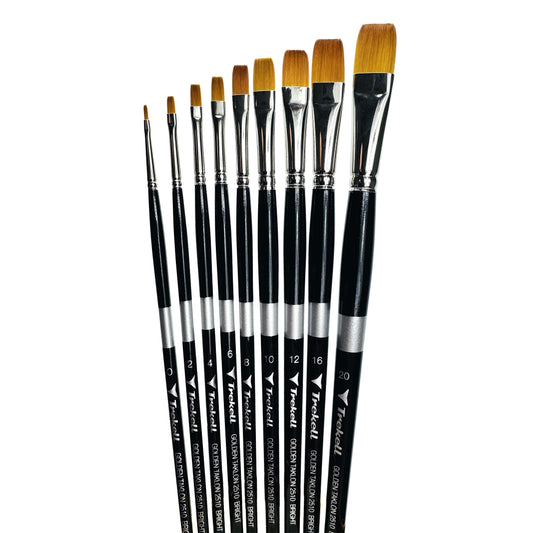

One brush shape can do more than you might expect. Trekell Pro Team Artist David Rice uses Golden Taklon Bright brushes for broad coverage, precise marks and soft transitions in oil paint. His approach comes down to knowing how to change the angle, pressure and part of the brush touching the canvas.
A square brush does not have to make only square marks. In David’s hands, the same Bright can establish a large area of color, create a clean line or paint a small circle.
Rather than constantly switching brush shapes, he explores what each Bright can do. Different sizes support different stages of the painting, while changes in handling give him control over both the image and the visible brushwork.
Watch David demonstrate the Trekell Golden Taklon Bright below.
Why David Reaches for a Bright
For David, the appeal of a Bright starts with its short bristles. They give him the response he wants when applying oil paint and moving it across the canvas.
“I like the short bristles of the Bright because I can scrub the brush into the canvas and it allows for a thicker paint application,” he explains.
He also values how the Golden Taklon bristles retain their shape and spring back during use. That consistency helps him move between different applications without losing the brush profile he relies on.
His preference is personal to the way he paints. The combination of size, stiffness and durability gives him control while still allowing his marks to remain visible.

Use the Whole Shape
David does not treat a Bright as a tool with one fixed purpose. He uses its broad face, narrow edge and corner depending on the mark he needs.
- The broad face covers larger areas quickly and establishes wider shapes.
- The edge creates clean, straight lines.
- The corner reaches tight areas and makes smaller, controlled marks.
Pressure changes the result, too. A lighter touch can produce a thin, delicate line, while firmer pressure creates a heavier mark.
In the video, David uses a #6 Golden Taklon Bright to paint small circles. It is a useful example of how a brush’s outline does not determine every shape it can create. The way you move and turn it matters just as much.
Before reaching for another brush, try changing the angle or using a different part of the bristles. You may already have the mark you need available.

Change Your Pressure When Blending
David also uses Golden Taklon Brights to soften transitions between areas of oil paint. He finds the shorter bristles easier to control than longer Flat brushes, helping him keep his movements consistent.
His touch changes depending on the stage of the work.
When blending a smaller transition, he uses very light pressure, barely touching the paint while moving the brush quickly back and forth. For a larger area, such as a sky, he first makes sure there is enough paint on the surface to blend.
“When I am trying to blend big areas like a sky in a landscape painting, I like to apply the paint thicker with heavy pressure so I have more material to work with. Then I can go back and use light pressure to finesse the gradient.”
The distinction is important. Applying the paint and refining the transition are two different tasks. David uses firmer pressure to put the material in place, then lightens his touch when it is time to soften the boundary.
To explore this yourself, place two neighboring areas of oil paint on your surface. Then reduce your pressure and work lightly where they meet. Notice how the transition changes as you adjust your touch.

Start Large, Then Refine
David changes brush sizes as a painting develops, but he begins with larger tools to establish coverage and the main shapes.
Sizes #20 and #16 are his usual starting points. As he moves toward smaller forms and finer detail, he reaches for sizes such as #8 and #6.
For David, a canvas larger than 30 inches by 30 inches is large scale. At that size, he says he generally completes about 90 percent of the painting with a #20 Bright before introducing smaller brushes near the end.
That is not a rule about which brush belongs on which canvas. It is an example of how much a larger brush can accomplish when the artist knows how to use its different surfaces.
Keeping a larger brush in your hand can also encourage you to solve the broader shapes before becoming absorbed in smaller details.

Give Yourself Room to Move
David prefers long-handle brushes because they allow him to maintain control while working farther from the canvas.
He usually grips the brush at the very back of the handle. For him, that position provides more freedom to move across the surface than holding it near the ferrule.
This becomes especially useful on larger paintings, where broader movements are part of the process.
If you tend to hold every brush close to the bristles, try moving your hand farther back for a few passages. Notice how that changes your movement and the marks you make. Handle position is another variable you can explore alongside angle and pressure.

Refine the Image Without Erasing the Brushwork
David wants enough control to develop detail, but he does not want every passage to lose its painted character.
“These brushes allow me to achieve a level of detail I am looking for, while also keeping some of the flat brush strokes that remind the viewer it is a painting not a photograph.”
That balance is central to why Golden Taklon suits his process. He can clarify a form, control an edge and refine a smaller area while still preserving broader marks elsewhere.
More blending is not always the answer. A visible stroke can be part of what gives a passage its energy and makes the paint itself interesting to look at.

Try David’s One-Brush Exercise
For someone new to the Bright shape, David recommends completing a painting with just one large brush, such as a #16 or #20.
The exercise removes the option of immediately switching tools when a different mark is needed. Instead, you have to explore what changes when you turn the brush, adjust your pressure or use a different part of its shape.
- Begin with the broad face to establish larger areas of color.
- Turn the brush onto its edge for narrower lines.
- Use the corner to reach smaller spaces.
- Adjust pressure to move between heavier and lighter marks.
- Use a gentle touch when blending transitions.
- Experiment with where you hold the handle.
The goal is not to prove that one brush is the best choice for every task. It is to discover what the shape can do before deciding you need something else.

The Takeaway
A Bright offers more than broad, square brushstrokes. David Rice uses its face, edge and corner for coverage, lines and smaller marks, then adjusts his pressure to move from applying paint to softening transitions.
The next time you pick up a Bright, spend a little time exploring it before switching brushes. Turn it, lighten your touch or move your grip farther back.
A familiar shape may have more range than you expected.
Tools David Uses
David uses long-handle Trekell Golden Taklon Bright brushes in several sizes throughout his oil painting process.
- Trekell Golden Taklon #20 Bright for broad coverage and much of his larger work
- Trekell Golden Taklon #16 Bright for establishing larger shapes and areas of color
- Trekell Golden Taklon #8 Bright for smaller passages and refinement
- Trekell Golden Taklon #6 Bright for controlled marks, small circles and detail