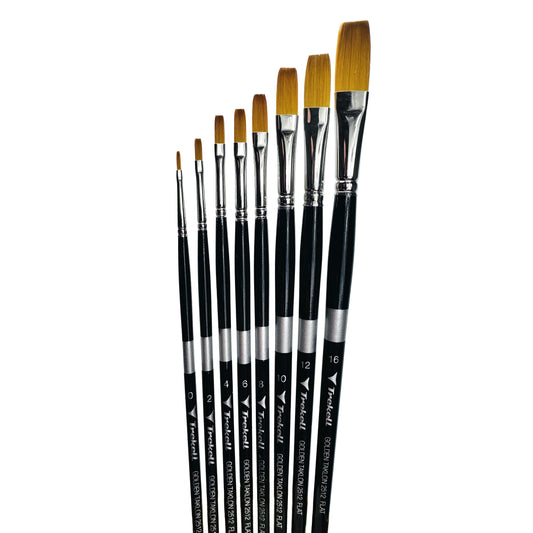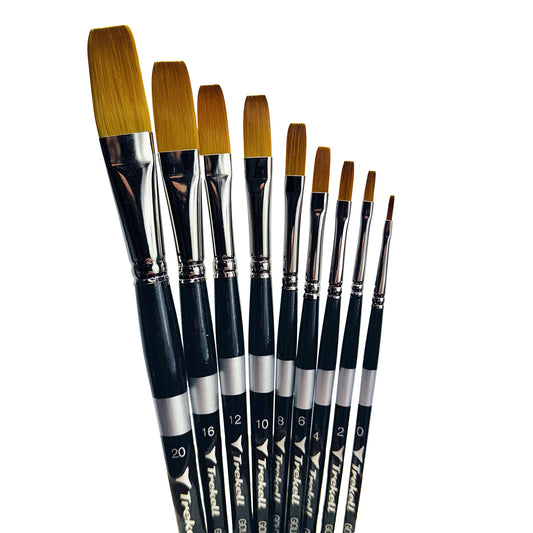

Un pincel plano puede parecer simple, pero puede hacer mucho más que solo bloquear formas. Con el ángulo y la presión adecuados, un pincel plano Golden Taklon puede manejar bordes limpios, sombreado suave, líneas finas y detalles delicados.
En esta publicación, la artista del equipo Trekell Pro Stefani Rabideaux explica cómo usa un solo pincel plano Golden Taklon para crear una de sus ilustraciones detalladas de principio a fin. Verá cómo el mismo pincel cambia de función simplemente por cómo lo sostiene y la cantidad de pintura que usa.
La obra de arte de Stefani: un pincel, muchos trabajos
La pieza que se muestra a continuación fue pintada usando un pincel plano Golden Taklon para la mayor parte del trabajo. Observe los bordes limpios, los degradados suaves y los detalles del cabello que provienen del mismo pincel.

En lugar de cambiar constantemente de pincel, Stefani se basa en el posicionamiento, la presión y la carga de pintura para obtener diferentes tipos de trazos del mismo pincel plano.
Cómo Stefani usa el pincel plano para bordes limpios
Una de las formas favoritas de Stefani de usar un pincel plano es para bordes nítidos y limpios. La punta cuadrada le permite "recortar" formas definidas contra fondos oscuros o claros.

Aquí, usa el lado ancho del pincel plano Golden Taklon a lo largo del borde de la figura para pintar el fondo oscuro. Al mantener el pincel firme y trabajar hasta el dibujo, obtiene una separación nítida entre el personaje y el color circundante.
Para probar el enfoque de Stefani:
- Cargue el pincel plano con suficiente pintura para un trazo sólido y opaco.
- Alinee el borde plano con el borde que está pintando.
- Tire del pincel con trazos suaves y seguros en lugar de trazos cortos y esquemáticos.
Mismo pincel, diferente volumen y sombreado
Stefani también usa el mismo pincel plano para alternar entre una cobertura ligera y suelta y trazos más ricos y enfocados. Todo se reduce a la presión y la carga de pintura.

En esta etapa de la pieza, ella usa el pincel de dos maneras diferentes:
- Trazos ligeros y sueltos para un sombreado suave en la figura y en el cabello.
- Trazos más ricos y enfocados para sombras más profundas y para definir las ondas del cabello.
Con una presión ligera y más agua o medio, el pincel aplica capas transparentes. Con una presión más firme y más pigmento, crea formas más fuertes y valores más oscuros. Stefani se mueve constantemente entre esos dos modos para construir profundidad.
Girando el plano para trazos finos y precisos
Stefani no siempre busca un delineador cuando necesita un trazo fino. A menudo, simplemente gira su pincel plano de lado.

Aquí, ella rota el pincel plano Golden Taklon para que esté pintando con el lado estrecho, no con el ancho completo. Eso le permite colocar marcas finas y precisas en pequeños detalles como las yemas de los dedos y las uñas, mientras sigue usando el mismo pincel que usó para áreas más grandes.
Si desea copiar esta técnica:
- Cargue solo la punta y el borde del pincel con pintura.
- Gire el pincel para que el borde sea lo que toque el papel o el panel.
- Use un toque ligero y deje que el borde se deslice a lo largo de su línea.
Capa ligera de reflejos y pequeños detalles
Una vez que las formas principales y las sombras están en su lugar, Stefani vuelve con trazos muy ligeros y controlados para agregar reflejos y movimiento adicional.

Para los reflejos del cabello en el agua, usa el pincel plano con muy poca pintura y presión suave. Los trazos cortos y ligeros sugieren movimiento y brillo sin dominar el dibujo ni aplanar el sutil trabajo a lápiz que hay debajo.
Piense en este paso como susurrar con el pincel en lugar de hablar en voz alta. Está ajustando los valores y las formas, no volviéndolos a pintar.
Por qué a Stefani le gustan los planos Golden Taklon para este tipo de trabajo
Golden Taklon es un filamento sintético suave que mantiene un borde limpio, una buena punta en las esquinas y libera la pintura de manera uniforme. Para el estilo de Stefani, con muchas ilustraciones, eso significa:
- Bordes nítidos cuando usa el plano completo para el bloqueo.
- Capas suaves y uniformes cuando aligera la presión para sombrear.
- Líneas finas consistentes cuando gira el pincel de lado.
En esta pieza, muestra cómo un pincel plano Golden Taklon puede manejar rellenos limpios, degradados, pequeños detalles y reflejos sutiles. Es una configuración mínima que aún le brinda mucho control.
Prueba el enfoque de pincel plano de Stefani en tu propio trabajo
Si quieres experimentar con el uso de un solo pincel plano como lo hace Stefani, prueba esto en tu próxima pieza:
- Usa el lado ancho del plano para rellenos de fondo y bordes limpios.
- Usa una presión más ligera y más medio para un sombreado y degradados suaves.
- Gira el pincel de lado para trazos finos y precisos y pequeños acentos.
- Termina con trazos muy ligeros para agregar reflejos y luces.
En lugar de cambiar de pincel cada pocos minutos, desafíate a ti mismo para ver cuántos trabajos puede manejar un pincel plano Golden Taklon. El proceso de Stefani es un gran ejemplo de lo lejos que puede llegar un solo pincel cuando se aprende todo su rango.
Para ver los pinceles planos Golden Taklon que usa Stefani y encontrar un tamaño que se adapte a tu trabajo, puedes explorar nuestros planos Golden Taklon aquí: Pinceles Planos Golden Taklon