
When Trekell Pro Team Artist Carlo Miranda decided to paint a crocheted balaclava, he was working with a subject full of color, pattern and texture he had never painted before. His solution was not to copy every loop of yarn. It was to find the structure underneath it.
Complex textiles can feel intimidating. Crochet, knitwear, lace and patterned fabrics all contain a huge amount of visual information. If an artist tries to paint every thread individually, the subject can quickly become overwhelming.
For this portrait on a Trekell Crescent Moon Panel, Carlo approached the balaclava as an experiment. He studied its repeating patterns, organized the value relationships and used selective detail to suggest the softness and construction of the material.
Watch the full painting demonstration below.
Look for Structure Before Detail
Carlo was drawn to this subject because he wanted to experiment with painting different materials and textiles.
“Lately I’ve been obsessed with observing the patterns in things,” Carlo says.
That observation became the starting point for the balaclava. Rather than seeing a mass of individual loops, colors and stitches, Carlo looked for the larger repeating structure that made the material read as crochet.
Understanding how the fabric is woven together helped him decide which details mattered most. The goal was not to reproduce every stitch. It was to make the painted version feel believable.
“I think it helped understanding how things are woven together so that when you paint it, it makes sense,” he explains.

Start with the Focal Point
Carlo began by preparing his Trekell Crescent Moon Panel, then moved into the face and hair before building the crocheted balaclava around them.
Starting with the portrait established the focal point of the composition. It also gave him a clear reference for the value and color relationships surrounding the face.
Once that foundation was in place, the balaclava could be simplified into larger shapes instead of being treated as hundreds of separate painted stitches.

Build Texture with Value
Carlo’s plan for the crochet was to establish the midtones and darks first, then return with highlights to suggest the surface texture of the yarn.
“My plan is to lay down the midtones and darks, then come back with some highlights,” Carlo says.
This sequence is useful for any complex material. Darker passages establish the recesses and overlap within the fabric. Midtones create the larger body of the form. Highlights can then be placed selectively to suggest the raised, soft surface of the crochet.
By working from larger value masses toward smaller details, Carlo kept the subject from becoming visually confusing.

Simplify What You See
The balaclava was not a straightforward single-color textile. It was woven with white yarn, then sprayed with a colorful pattern. As the fabric stretched, portions of the white yarn showed through between the colors.
That created a lot of competing information in the reference, particularly when it came to value.
“The biggest challenge was getting the values correctly in the multitude of colors,” Carlo says. “As the fabric stretched, the white showed through, which overcomplicated the subject.”
Instead of reproducing every shift in color and every exposed bit of yarn, Carlo simplified the information in front of him.
“I didn’t necessarily paint what I saw, but what made sense.”
That is a useful distinction for artists working from reference. A painting does not have to copy every visible detail to feel accurate. In many cases, simplifying the reference helps the material read more clearly.

Find Order in Complex Subjects
Patterned fabric can become overwhelming when every color, stitch and edge demands equal attention. Carlo’s approach was to organize the chaos.
By grouping the balaclava into larger areas of light, middle and dark values, he could create form first. The smaller shifts in color and texture then became supporting details rather than distractions.
“Our brains don’t like to look at complex, convoluted things, so when you find the pattern and organization in things, it’s pleasing to the eye,” Carlo says.
This idea applies to far more than crochet. It can help when painting lace, patterned clothing, foliage, hair, reflections or any subject that appears difficult because it contains too much visual information.

Choose the Right Mark
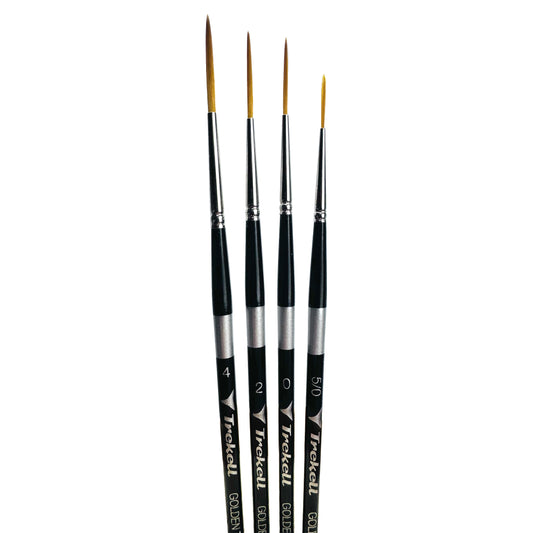
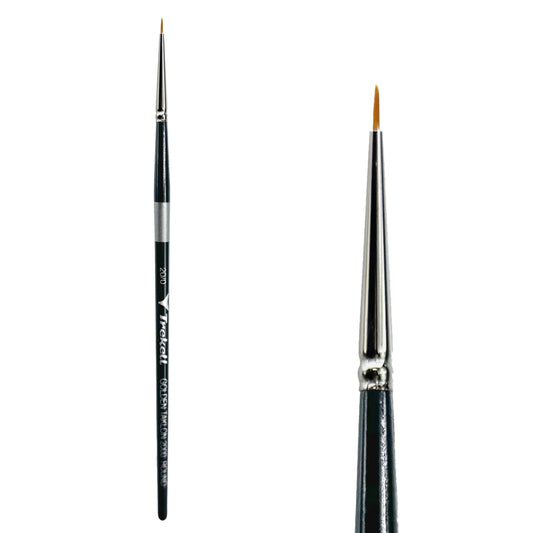
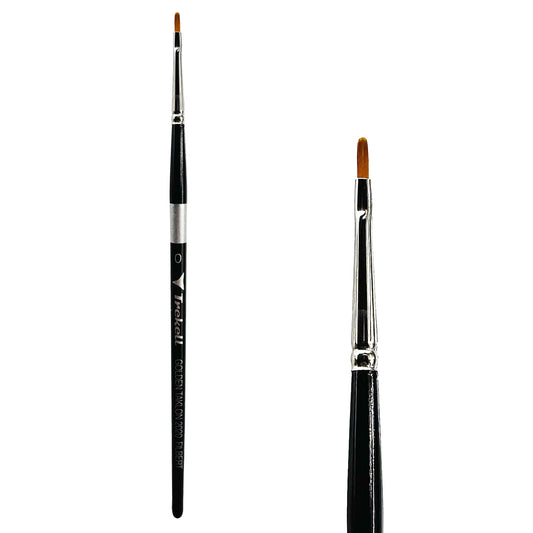
Carlo used Trekell Golden Taklon brushes for the painting, including Script, Round and Filbert shapes. Each shape helped him make a different kind of mark as the portrait and textile developed.
- Trekell Golden Taklon Filbert: Useful for broader passages, curved forms and softer transitions.
- Trekell Golden Taklon Round: Useful for controlled shapes, smaller forms and refined detail.
- Trekell Golden Taklon Script: Useful for long, fine linear marks and delicate detail work.
The best brush is not determined by the subject alone. It is determined by the mark you need. A complex textile may require broad, soft passages in one area and fine linear accents in another.

Use Removal as a Painting Tool
Carlo did not create every detail by adding paint. He also used a Trekell Wipe Out Tool to carve out the marigolds in the composition.
When working into wet paint, removing paint can clarify a shape, sharpen an edge or reveal part of the layer underneath. It can be especially effective for small details that would become muddy if more paint were added on top.
The Wipe Out Tool is a reminder that creating detail is not always about reaching for the smallest brush. Sometimes the clearest mark comes from taking paint away.

Paint the Idea of Crochet
The finished balaclava reads as soft, colorful crochet, even though Carlo did not paint every piece of yarn individually.
When painting a detailed material, try simplifying the problem:
- Look for the pattern that organizes the surface.
- Establish large value relationships before adding texture.
- Consider how the material is constructed.
- Use detail where it helps explain the form.
- Leave out information that distracts from the overall image.
A few well-placed details can communicate texture more effectively than an exact rendering of every stitch.
The Takeaway
Carlo Miranda’s crocheted balaclava began as an experiment in painting an unfamiliar material. By studying its structure, organizing its values and simplifying what he saw, he turned a complicated textile into a clear and convincing painted surface.
When a subject feels too detailed to paint, do not begin by trying to copy everything. Start with the pattern, the value structure and the overall form. Then add only the details that make the subject feel real.