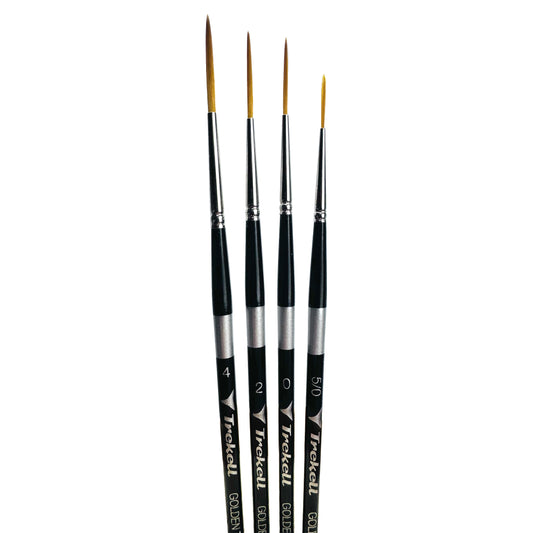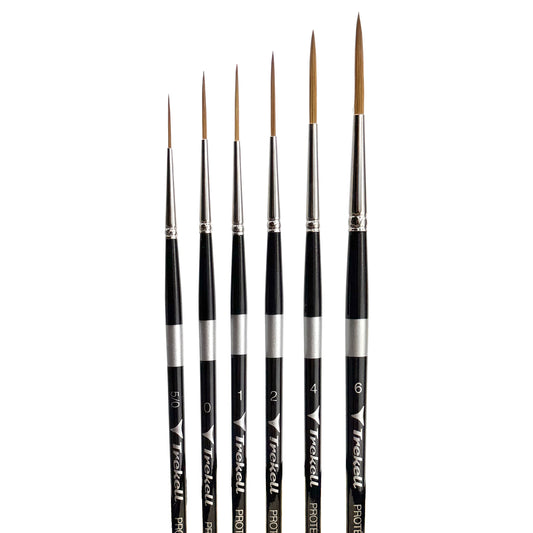

Los pinceles para delinear, o "script/rigger brushes", parecen delicados, pero son algunas de las herramientas más potentes que puedes añadir a tu estudio. Están diseñados para líneas largas y continuas, detalles finos y marcas expresivas que otras formas de pincel tienen dificultades para lograr.
En esta publicación, desglosaremos qué son los pinceles para delinear, qué los diferencia de los pinceles redondos comunes, cómo se sienten las diferentes líneas sintéticas de Trekell en esta forma y formas prácticas de usarlos en tu propio trabajo. También compartiremos cómo la artista del equipo profesional de Trekell, Stefani Rabideaux, usa sus pinceles para delinear, con un video que puedes ver directamente en esta página.
¿Qué es un pincel para delinear (script/rigger brush)?
Escucharás a los artistas decir "pincel script" o "pincel rigger" para la misma forma básica, por eso los llamamos pinceles script/rigger.
Un pincel para delinear es un pincel redondo largo y delgado con cerdas que terminan en una punta fina. La longitud del pelo es notablemente más larga que la de un redondo estándar del mismo tamaño, y esa longitud adicional es lo que te permite conseguir esas líneas elegantes y fluidas.

Los pinceles para delinear están diseñados para:
- Retener más pintura fluida que un pincel de detalle diminuto o un redondo corto.
- Trazar líneas largas e ininterrumpidas sin recargar constantemente.
- Crear curvas suaves y trazos afilados con cambios de presión muy ligeros.
Históricamente, los "riggers" se utilizaban para pintar el aparejo de los barcos en las pinturas marítimas, de ahí su nombre. Hoy en día, los artistas utilizan los pinceles script/rigger para todo, desde pestañas y cabello hasta letras, enredaderas, bigotes y detalles decorativos.
Por qué los pinceles script/rigger de Trekell se sienten diferentes
Todos los pinceles script/rigger de Trekell comparten la misma forma básica: pelos largos y delgados que terminan en una punta fina para líneas suaves y fluidas. La principal diferencia es el filamento y el mango, que cambian la sensación del pincel en la mano y cómo responde en la superficie.
Ofrecemos pinceles script/rigger en varias líneas sintéticas, cada una con su propia personalidad:
- Golden Taklon – Un sintético versátil de firmeza media que mantiene una punta afilada y funciona con acrílicos, acuarelas, óleos, gouache, tinta y más. Ofrece un buen equilibrio entre elasticidad y suavidad, lo que lo convierte en una excelente opción para trabajos de línea limpios y controlados.
- Crimson Taklon – Un sintético más rígido con más elasticidad que el Golden Taklon. Está diseñado para artistas que prefieren una sensación más firme, especialmente cuando trabajan con acrílicos y óleos de cuerpo más pesado, a la vez que funciona bien en otros medios.
- Spectrum – Un sintético suave similar al pelo natural que imita el aspecto y la sensación de los pinceles tipo sable de lujo, manteniendo la durabilidad de las cerdas sintéticas. Los pinceles script/rigger Spectrum son ideales si buscas un toque más suave y sedoso con alta elasticidad y retención de forma.
- Sienna Synthetic Red Sable – Una línea sintética de sable rojo diseñada para imitar el sable natural con excelente elasticidad, retención de forma y una sensación refinada. Los pinceles script/rigger Sienna son una excelente opción si buscas esa "belleza artística" del sable rojo en un pincel apto para todos los medios y vegano que funciona para óleo, acrílico, gouache, acuarela y tinta.
- Protégé – Una línea sintética centrada en la acuarela que retiene una generosa cantidad de agua y pigmento, volviendo a una punta fina. Los pinceles script/rigger Protégé son una opción sólida para acuarela y tinta fluida donde el flujo y la suavidad son lo más importante.
Todas estas líneas son sintéticas y veganas, por lo que puedes elegir según la sensación y el medio en lugar de preocuparte por el cuidado o la procedencia del pelo natural.
¿Qué línea de pinceles script/rigger deberías elegir?
Si no estás seguro por dónde empezar, aquí tienes una forma sencilla de pensar al respecto:
- Si quieres un pincel script/rigger que pueda hacer un poco de todo, empieza con Golden Taklon. Es una opción equilibrada y fiable para la mayoría de los medios y estilos.
- Si trabajas con texturas densas y te encantan las líneas firmes y elásticas en óleo o acrílico, prueba Crimson Taklon. La rigidez extra ayuda al pincel a recuperarse rápidamente y a controlar la pintura más pesada.
- Si quieres una sensación más suave, similar a la del pelo natural, con alta elasticidad, elige Spectrum. Es ideal cuando quieres la precisión de un pincel de detalle con un toque más suave y lujoso.
- Si quieres un pincel de detalle estilo sable rojo sin pelo natural, opta por Sienna Synthetic Red Sable. Te ofrece esa sensación clásica del sable en un pincel sintético que funciona con óleo, acrílico, gouache, acuarela y tinta.
- Si eres principalmente un artista de acuarela o medios fluidos, los pinceles script/rigger Protégé están diseñados para retener más líquido y liberarlo suavemente, facilitando las líneas largas y continuas.
Siempre puedes mezclar y combinar. Muchos artistas conservan un pincel script/rigger más firme para pinturas más pesadas y una opción más suave y fluida para acuarelas, tintas o detalles muy delicados.

Cómo cargar un pincel script/rigger para líneas limpias
Los pinceles script/rigger rinden mejor cuando la pintura tiene la consistencia adecuada. Demasiado espesa, y el pincel se arrastrará o saltará. Demasiado fina, y la línea puede perder opacidad o empezar a gotear.
Para obtener el mejor rendimiento:
- Diluye ligeramente tu pintura con agua o medio hasta que tenga una consistencia similar a la tinta o a la crema espesa, según el medio que utilices.
- Gira la punta del pincel script/rigger en la pintura y luego gíralo suavemente sobre tu paleta para que vuelva a su punta.
- Prueba algunas líneas en una superficie de prueba. Deberías poder trazar una línea suave y continua sin presionar con fuerza.

Si el pincel deja líneas secas y discontinuas, es probable que la pintura sea demasiado espesa o que no hayas cargado suficiente en las cerdas. Si la línea se extiende o es difícil de controlar, la pintura puede ser demasiado fina.
Técnicas básicas para probar con un pincel script/rigger
Una vez que el pincel está cargado, pequeños cambios en la presión y la velocidad te darán una sorprendente variedad de marcas.
- Líneas uniformes – Sostén el pincel en un ligero ángulo y mantén una presión constante mientras trazas, con la muñeca relajada. Esto es ideal para contornos, letras y líneas estructurales.
- Trazos cónicos – Comienza con un poco más de presión y disminúyela gradualmente mientras trazas para crear una línea que se desvanece de grueso a fino. Perfecto para cabello, bigotes, pestañas y enredaderas.
- Curvas y filigranas – Usa todo el brazo en lugar de solo la muñeca para curvas más largas y amplias. Los pelos largos ayudan a que tu línea se mantenga suave incluso sobre pequeñas irregularidades en la superficie.
- Líneas rotas y texturizadas – Sobre una superficie ligeramente más seca, muévete más rápido o levanta suavemente a medida que avanzas para crear marcas caligráficas texturizadas.
Puede ser útil practicar esto en un panel de prueba o en un trozo de papel primero, solo para tener una idea de cuánto dura una sola carga de pintura y cómo los cambios de presión afectan la línea.

Cómo Stefani Rabideaux usa los pinceles script/rigger
La artista del equipo profesional de Trekell, Stefani Rabideaux, utiliza pinceles script/rigger para detalles precisos y expresivos en su obra. En el siguiente video, demuestra cómo carga el pincel, la forma en que lo sostiene para tener control y los tipos de líneas y acentos que le gusta crear.
Presta atención a cómo:
- Ajusta la consistencia de la pintura para que el pincel se deslice en lugar de saltar.
- Utiliza cambios de presión para pasar de líneas finas como cabellos a trazos ligeramente más audaces.
- Trabaja con la longitud de las cerdas en lugar de luchar contra ellas, dejando que el pincel haga parte del trabajo.
Observar su proceso puede darte una idea más clara de cómo se ve un "buen" flujo antes de intentarlo tú mismo.
[insertar aquí el video incrustado del pincel script/rigger de Stefani Rabideaux]
Formas prácticas de utilizar los pinceles script/rigger en tus propias pinturas
Una vez que te familiarizas con la sensación de un pincel para delinear, se convierte rápidamente en una herramienta esencial para tareas específicas que otros pinceles no manejan tan bien.
- Cabello y pelaje – Usa trazos largos y cónicos para construir hebras de cabello, bordes de pelaje o bigotes sobre una capa base existente.
- Pestañas, cejas y detalles faciales finos – Líneas ligeras y controladas pueden sugerir pestañas y pequeños vellos sin opacar el resto de la pintura.
- Ramas, enredaderas y tallos – Los pinceles para delinear son perfectos para formas vegetales delicadas y líneas trepadoras que necesitan sentirse vivas y continuas.
- Letras y trabajos de línea decorativos – Para títulos escritos a mano, halos, bordes o detalles de patrones, un pincel para delinear se comporta como una pluma flexible.
- Destacados y toques finales – Usa la punta muy fina con un color más claro para colocar pequeños brillos, reflejos en los bordes y acentos finales.
No tienes que usar tu pincel script/rigger en todas partes. Piensa en él como tu herramienta de "detalles finales" a la que recurres en las últimas etapas de una pieza.
Consejos de cuidado para mantener los pinceles script/rigger en buen estado
Debido a que los pinceles script/rigger tienen pelos largos y finos, unos pocos hábitos de cuidado sencillos les ayudarán a durar mucho más:
- Límpialos a fondo después de cada sesión, especialmente cerca de la virola, para que la pintura seca no endurezca la base de los pelos.
- Remodela suavemente la punta mientras el pincel aún está húmedo.
- Sécalos planos o con las cerdas hacia abajo, en lugar de erguidos en un recipiente.
- Evita frotar o aplicar mucha presión sobre superficies rugosas con tu pincel script/rigger. Resérvalo para trabajos de línea y detalles, y usa pinceles más rígidos para frotar o para el pincel seco.
Un pincel script/rigger bien cuidado mantendrá su punta y elasticidad por mucho más tiempo, que es exactamente lo que buscas para un trabajo de línea limpio y seguro.
Añadir un pincel script/rigger a tu set mínimo
Si ya tienes un juego mínimo de pinceles redondos y planos, añadir un pincel script/rigger es una de las formas más fáciles de expandir lo que puedes hacer sin comprar una gran colección.
Con solo uno o dos pinceles script/rigger en tamaños que coincidan con la escala de tu trabajo, puedes manejar:
- Pintura suelta y gestual con tus pinceles redondos, avellanados y brillantes existentes.
- Estructura limpia y bloques de color con tus pinceles planos.
- Líneas finas y expresivas y detalles finales con tu pincel script/rigger.
Es una pequeña adición que puede hacer que tu kit de pinceles se sienta mucho más completo, especialmente si te encanta el trabajo de detalle, la ilustración, el arte de personajes o los acabados decorativos.
Para ver las diferentes opciones de pinceles script/rigger en Golden Taklon, Crimson Taklon, Spectrum, Sienna Synthetic Red Sable y Protégé, puedes explorar nuestros pinceles script/rigger aquí: PINCELES SCRIPT AQUÍ.