
When Trekell Pro Team Artists Alex Garant and James Ormiston painted portraits of each other, there was one rule. They had to use the other person’s favorite brushes.
Why Swap Brushes at All?
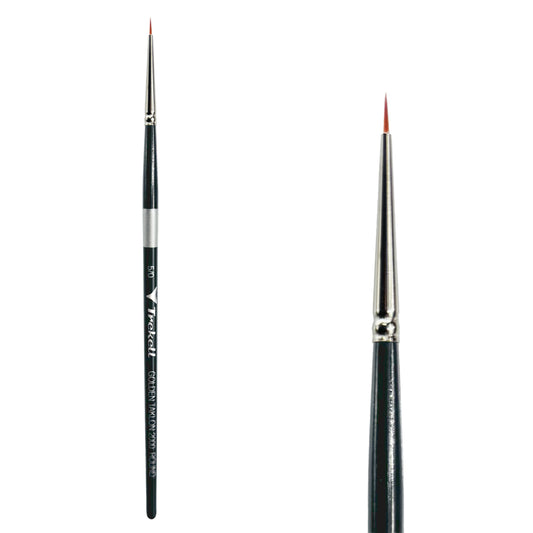
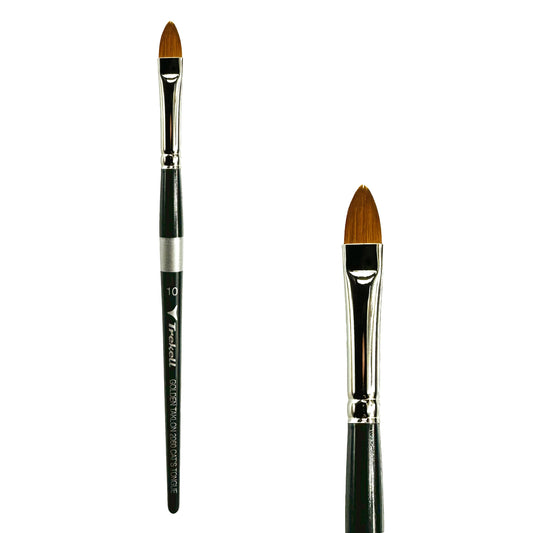
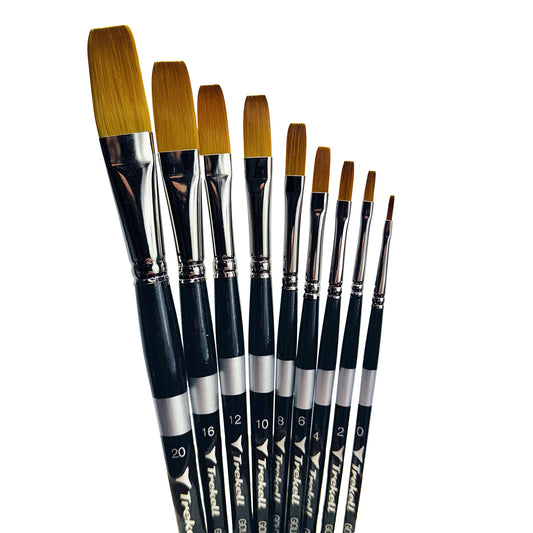
Every artist develops habits in the studio. The brushes you reach for, the way you hold them and the motions you make across the canvas all become second nature over time. Alex is known for her surreal oil portraits and buttery smooth blends, built with small Golden Taklon rounds, cat’s tongue brushes and soft mop brushes. James, on the other hand, relies on flat brushes and a pixel like way of placing paint.
For this six minute portrait challenge, they decided to trade tools. Alex painted James using his flats. James painted Alex using her small round, cat’s tongue and mop brush. The portraits were of each other. The tools were completely unfamiliar.
Alex: Learning to Paint with Flats
Alex’s usual process is built around dabbing color into place. She studies her reference in color zones and taps small marks onto the surface with her Golden Taklon rounds, cat’s tongue and mop. Switching to flats changed that immediately.
“I usually analyze my reference image by color zone and try to replicate it by dabbing the canvas. With flats, I found myself having to slide the brush across the surface instead of dabbing it. The shape of the brush redefined my physical movements.”
It was not just the marks that changed. The way she held the brush and moved her arm had to adapt. Even after years of repeating the same motion, the slightest change of tool required new adjustments.

Finding What Flats Do Well
At first, flats felt difficult and unfamiliar. But once she stopped trying to make them behave like her usual brushes, Alex discovered a strength she had not expected.
“I really appreciated the sharpness of the edge when painting hair. By loading the brush carefully and using almost no pressure, I was able to create really nice, thin hair strands.”
She mostly reached for the largest flat, because she felt she could control the pressure better. By leaning into the natural edge of the brush, she began to use it for what it did best instead of forcing it into her old routine.

Would Flats Join Her Regular Toolkit?
By the end of the portrait, Alex was surprised to realize that flats had earned a place in her studio.
“Yes, they would be complementary to my current roster of brushes, especially for the final stages and detail work.”
If she did the challenge again, she says she would ask James to send a larger range of sizes, both smaller small brushes and larger large brushes, to push the experiment further.

Alex’s Advice on Trying New Brushes
When asked what she would say to an artist who is hesitant to try a different brush shape, Alex’s answer is simple.
“The need to experiment and better ourselves as artists is such an important part of the artist journey. Trying new materials is a good way to attempt to improve our art and see what works, and sometimes what doesn’t.”
She still believes it is healthy to know what works in the studio. The tools you use help define your style. The goal is not to replace every familiar brush, but to stay open to tools that might add something new.

James: Trading Flats for Cats’ Tongues and Mop Brushes
James normally paints in tiny, pixel like brushstrokes using flats. He places small squares of color side by side and lets gradients appear over time. That approach fits the clean, square edge of a flat brush.
Alex’s favorite brushes are the opposite. Her Golden Taklon cat’s tongue and mop brushes are designed for soft edges, smooth blends and almost invisible strokes. For James, that meant rethinking his entire approach.

First Impressions of Alex’s Brushes
“I have a very particular approach where I tend to paint in pixel like brushstrokes. Flats, with their sharp, square edges, lend themselves nicely to this. Alex’s cat’s tongue and mop brushes are the antithesis to this. They’re better at creating smooth, seamless transitions, so I had to rethink my entire process.”
The mop brush, in particular, felt strange at first.
“Soft edges, seamless blends, invisible brushstrokes. That is everything I stand against.”

How the Mop Brush Won Him Over
Despite his resistance, the mop brush slowly became the surprise favorite. James admits that he spent the early stages trying to make Alex’s brushes perform the same tricks as his flats. At some point, he let them do what they were made for.
“My work deals a lot with memory and nostalgia, and I found that blowing out the edges with the mop adds a hazy, analogue film effect that, despite myself, injects the very sense of nostalgia I was going for.”
By letting the mop brush soften edges instead of fighting it, he achieved a slightly blurry, decayed film look that fit his themes better than he expected.

Did It Change His Practice?
The challenge did more than change one portrait. It may have shifted James’s broader direction.
“Not only the portrait, but possibly the direction of my whole practice, which is actually very inconvenient because I am midway through preparing for a solo show and that is not the ideal time for an abrupt shift in aesthetic. But I am obsessed with the slightly blurry, decayed film look I achieved with the mop brush, so I am seeing where that goes.”
Both the cat’s tongue and the mop brush have now made their way into his regular rotation. His flats, he jokes, are “staring at them jealousy from across the palette.”

James’s Advice on Leaving the Comfort Zone
James describes himself as someone who hates change. His life is structured around routine and predictability. Even so, he begrudgingly admits that shaking things up has helped breathe new life into his studio practice.
His advice for artists who are hesitant to try a different brush shape is to acknowledge that comfort is important, especially when you rely on your tools for daily work, but also to recognize the need for challenge.
“Part of being a working artist is finding tools and approaches that work reliably well. Another important part is keeping things interesting, and that usually means challenging yourself with new approaches, new directions and yes, new tools.”
He also points out that the goal of a challenge like this is not to prove your usual technique works under every circumstance. It is to let unfamiliar tools teach you something new. Sometimes the best ideas come from giving up a little control.

What This Brush Swap Reveals
For both Alex Garant and James Ormiston, painting each other’s portraits with unfamiliar brushes did not erase their styles. It highlighted them.
- Alex discovered how flat brushes can sharpen hair and fine lines, and how small changes in tool affect the way she moves across the canvas.
- James discovered how cat’s tongue and mop brushes can create hazy, nostalgic edges that fit his themes of memory and analogue imagery.
- Both artists were reminded that experimentation does not have to replace trusted tools. It can expand what those tools can do.
Whether you usually work with flats, rounds, cat’s tongues or mop brushes, each shape has its own strengths. Picking up a brush you never use may feel awkward at first, but it can also reveal movements, edges and surfaces you would not have found any other way.
Sometimes the most useful thing you can do for your practice is to borrow someone else’s favorite brush and see what it teaches you.