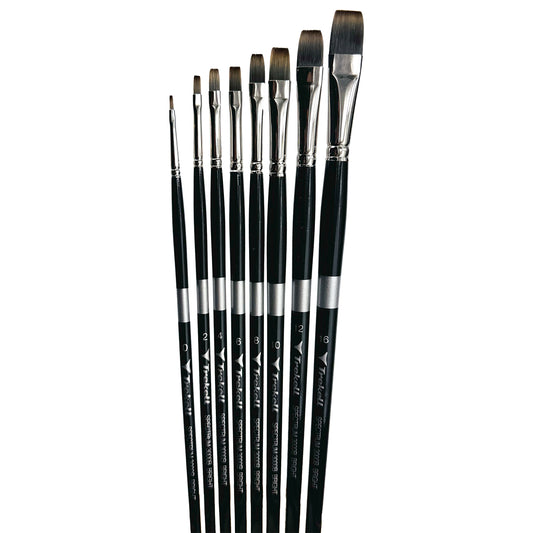

Trekell Pro Team Artist Josh Sorrell paints a 5" x 5" portrait using only three Trekell brushes and shares one of the biggest lessons he has learned over the last decade: recognizing a successful brushstroke and having the confidence to leave it alone.
Working Small with Just Three Brushes
For this portrait, Josh challenged himself to work on a 5" x 5" wood panel using only three Trekell brushes from the Spectrum and Hog Bristle lines. Two are Hog Bristle fan brushes, and the third is a Spectrum bright.
On a panel this small, even the smallest brush feels relatively large. That limited toolkit helped simplify his process. Instead of chasing tiny details, Josh had to think about shapes, value, and brushwork with every stroke.

Great Paintings Often Feel Effortless
During this series of 5" x 5" paintings, one observation stood out. This portrait took less time than the other four and still turned out the best.
Josh notes that this is not unusual for him. Many of his favorite paintings are also the ones that felt the most effortless to create. Rather than forcing every detail into place, he focused on making strong decisions early and allowing the painting to develop naturally. Sometimes confidence produces a stronger result than perfectionism.

Learning to Recognize a Great Brushstroke
One of Josh’s favorite areas in this painting appeared almost immediately. Using the hog bristle fan brushes in the early stages, he created loose, wispy marks in the lower right corner that had movement and energy he could not have planned.
He recognized those strokes as special and decided to protect them for the rest of the painting. As he says, those are the marks you cannot replicate a second time if you tried. Knowing when not to paint can be just as important as knowing where to paint next.

Shape Based Drawing and Big Value Masses
Josh follows a shape based approach to drawing. Rather than starting with small facial features, he begins by establishing the larger value masses first.
He blocks in the negative space, identifies midtones and highlights, and gradually builds the portrait from large, simple shapes before refining smaller forms. This method creates a strong foundation while keeping the painting loose and expressive.

Why Limiting Your Brushes Can Help
Using only two hog bristle fan brushes and one Spectrum bright held Josh back from overworking detail on a small panel. The fan brushes left thin, broken strokes and texture, while the bright gave him more solid, controlled marks when he needed to reinforce structure.
Working with bigger brushes relative to the panel size forced him to stay focused on overall design instead of tiny corrections. Sometimes fewer choices lead to better decisions.

A Simple Color Palette
Although several colors were already on his palette from other paintings, Josh only needed a handful to complete this portrait. His working palette included:
- Ultramarine blue
- Yellow ochre
- Cadmium yellow
- Cadmium yellow light
- Titanium white
- Ivory black
This limited palette kept the color relationships simple and let the brushwork and value structure carry most of the image. It is a reminder that rich, expressive paintings do not require dozens of paint colors.

Meet “Defiant”
Josh titled the finished painting Defiant, inspired by the mood that emerged as the portrait developed. Using himself as the reference, he noticed an intensity in the downward gaze and deep shadows that gave the piece a quiet sense of resistance.
Interestingly, the title came naturally after the painting was finished rather than before it began. It raises a question for viewers: if you saw this painting without knowing its title, what emotion would you give it?
Products Used
Final Thoughts
Josh Sorrell’s demonstration is not only about painting with three brushes on a small panel. It is about trusting your instincts. Learning to recognize successful brushwork, resisting the urge to overwork a painting, and simplifying your process are lessons that apply whether you are painting a portrait, landscape, or still life.
Sometimes the most important brushstroke is not the next one. It is knowing when you have already painted enough.